A Tale of Quantum Randomness
In City Q, a boy named Haru finds a little box in a factory scrap yard. Its display shows three digits.
A new English translation of the original Japanese manuscript, preserving its chapter and verse numbering.
Contents
Chapter 0 · Before the Story Is Observed
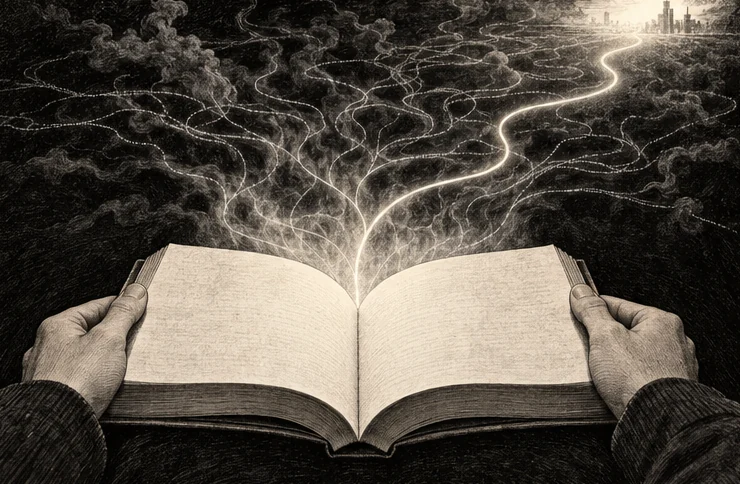
0:1This story begins with a single random number.
0:2Yet even that number, until it is observed, is only a cloud of possibilities.
0:3As you read these letters, one story takes definite shape, and all the others quietly fade.
0:4The history of the Religion of Quantum Randomness, that curious fellowship whose faith was superposition, is one branch chosen in just this way.
0:5Here, in chapters and verses like those of their scriptures, we shall tell it from its beginning to its end.
0:6Remember, though, that on other, untold branches they might never have come into being. Or they might have saved the world.
0:7What we observe now is this one “story function” alone.
Chapter 1 · Before Observation
1:1Before time had been given a name, people believed the world was already settled.
1:2Tomorrow was the continuation of today. Causes produced effects. Trajectories ran smoothly on. Such was the teaching on which they grew up.
1:3A boy called Haru was one of them. Born in a poor district in the shadow of the factories on the outskirts of City Q, he could hold his own against anyone when it came to numbers.
1:4His father was a maintenance mechanic, his mother a night cleaner. Both were exhausted, and when they talked of the future, they always said the same thing.
1:5“It’s all decided anyway.”
1:6Haru hated those words.
1:7If everything really was decided, then however hard he worked, however much he hoped, the outcome would be the same.
1:8What good was understanding numbers in a world like that? He could see none.
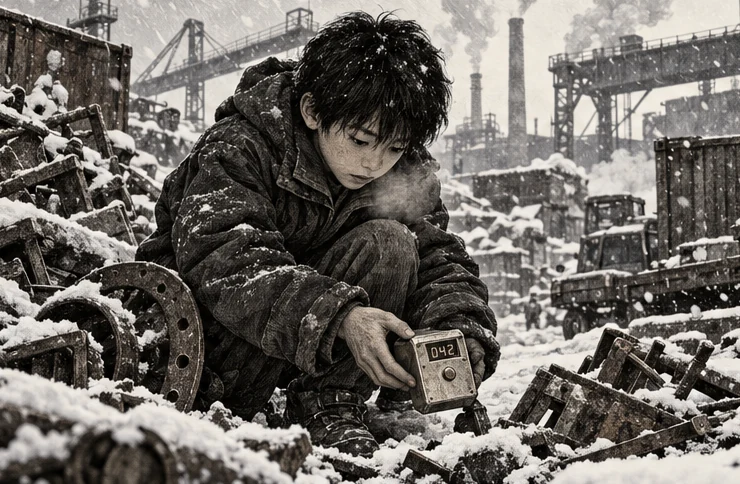
1:9One winter’s day, among the discards in the factory scrap yard, Haru came across a peculiar device.
1:10A small metal box. Engraved on its face were the characters “Q-RNG 01.”
1:11A button and a display a few digits wide. When he switched it on, a fan began to turn quietly, and a number appeared.
1:12【042】
1:13“…What’s this?”
1:14The manual was lost. He could just make out the label on the back. “A true random number generator employing quantum tunnelling. Its output is entirely unpredictable and cannot be reduced to any deterministic algorithm.”
1:15Haru read those words over and over.
1:16The words “entirely unpredictable” cut straight into the hard knot his distrust of determinism had become.
1:17What if, at the bottom of the world, there was something purely, honestly unknowable?
1:18What if everything had not been settled in advance?
1:19That night, for the first time, Haru used the device to pray.
1:20“If tomorrow will be different from today, give me a number greater than a hundred.”
1:21He closed his eyes and pressed the button.
1:22【173】
1:23In that instant, the way he saw the world shifted, very slightly and for good.
Chapter 2 · Between Zero and One
2:1Haru gave the device a name. He called it the Sacred Randomizer.
2:2He was half joking, but when he said the name aloud, he was surprised at how well it fit.
2:3The Sacred Randomizer returned a different number each time.
2:4The numbers meant nothing, or so they ought to have done.
2:5But Haru felt that their very lack of meaning was more precious than anything else.
2:6When they studied probability at school, his teacher said,
2:7“Toss a coin and it lands heads or tails. The probability is one half.”
2:8Yet the coin, the throwing hand, even the air were all subject to definite physical laws.
2:9“In principle, we ought to be able to calculate the whole thing,” the teacher went on.
2:10That night, stroking the Sacred Randomizer, Haru whispered,
2:11“What about you? Can’t you be calculated?”
2:12He began asking it questions.
2:13“Will Dad be in a good mood tomorrow?” → 【001】. No, as he interpreted it.
2:14“Will I pass my maths test?” → 【789】. Yes, as he interpreted it.
2:15Of course, numbers were just numbers.
2:16Haru himself made the rule that zero through four hundred and ninety-nine meant no, and five hundred through nine hundred and ninety-nine meant yes.
2:17It was Haru who supplied the meaning, all on his own.
2:18Even so, he felt the device was his one window onto the world’s unsettledness, something he could touch with his fingertips.
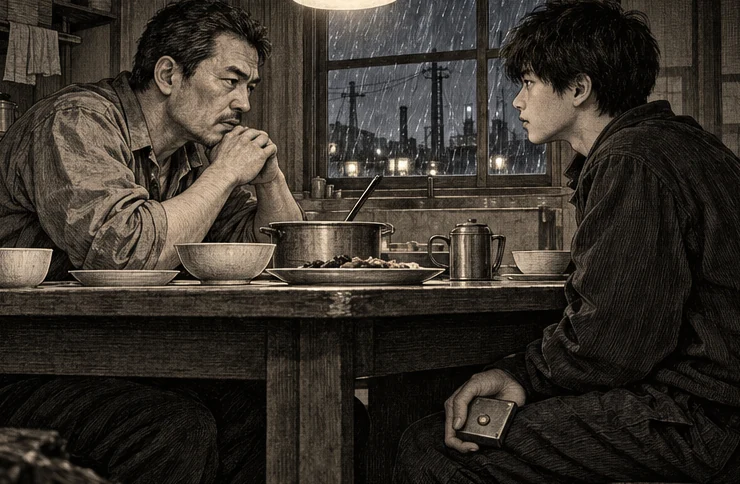
2:19As he was about to enter high school, he and his father had a bitter argument over his future.
2:20“University’s beyond you,” his father said. “Go into the factory. Take the same road I did.”
2:21Under the table Haru quietly tightened his grip on the Sacred Randomizer.
2:22“Should I go on to university?”
2:23He put all the prayer he had into pressing the button.
2:24【500】
2:25The number exactly on the threshold.
2:26A doubtful boundary, not easily called either yes or no.
2:27Haru couldn’t help laughing.
2:28“I see. The world isn’t zero or one after all. It’s somewhere in between.”
2:29That night he bowed his head to his father.
2:30“I’ll work at the factory. But I’ll keep studying at night.”
2:31Neither an outright yes nor an outright no.
2:32He had taken the Sacred Randomizer’s half-answer and made it the pattern of his life.
Chapter 3 · The First Measurers
3:1Working at the factory and attending night school made for a life of cruel monotony.
3:2The smell of oil, the vibration of the machinery, the sighs of exhausted workmates.
3:3But Haru had a secret nobody else knew.
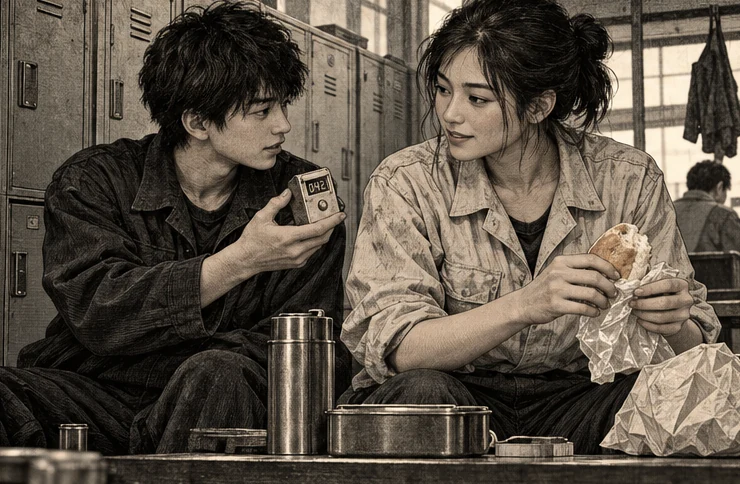
3:4Whenever a break came round, he would take out the Sacred Randomizer in the shadow of the lockers.
3:5“Whom should I talk to today?”
3:6“Should I put this idea forward?”
3:7He brought random numbers into the smallest details of his life.
3:8His workmate Mina was the first to notice.
3:9She was a little older than Haru, and her eyes had the look of someone who could not quite give up.
3:10“Hey. What’s that box?”
3:11One day she asked him quite out of the blue.
3:12After some hesitation, Haru told her everything.
3:13His unease with determinism, his longing for chance, the unpredictability of the Sacred Randomizer.
3:14Mina listened without a word, then said,
3:15“So it’s a sort of god that decides things for us?”
3:16“It’s no god. It’s just a device.”
3:17Even as he denied it, somewhere inside he feared the word.
3:18If this became a god, where would that leave him?
3:19Mina smiled.
3:20“But until now other people have decided everything in our lives. Parents, companies, the way things are set up. If we could let the movement of the world itself decide, at least… I think I’d like that a little better.”
3:21From that day on, the two of them drew numbers together.
3:22Whether to stop somewhere on the way home from work. Who got the first piece of leftover bread.
3:23As they entrusted these little choices to the Sacred Randomizer, they drew closer by degrees.
3:24One evening Mina said quietly,
3:25“Haru. This isn’t a game any more, is it?”
3:26“What do you mean?”
3:27“We pray to the unknowable thing at the bottom of the world. We decide our futures. We accept sorrow and receive joy. Doesn’t that already sound like a religion?”
3:28Haru looked at the Sacred Randomizer.
3:29Its numbers said nothing.
3:30But he could no longer call their silence meaningless.
3:31“Then I suppose we’re its first believers.”
3:32“No.” Mina shook her head.
3:33“Its first Measurers.”
3:34Before they knew it, that name had become a watchword between them.
3:35With Haru and Mina, the two Measurers, the story of the Religion of Quantum Randomness began in earnest.
Chapter 4 · The Wavering Determinist
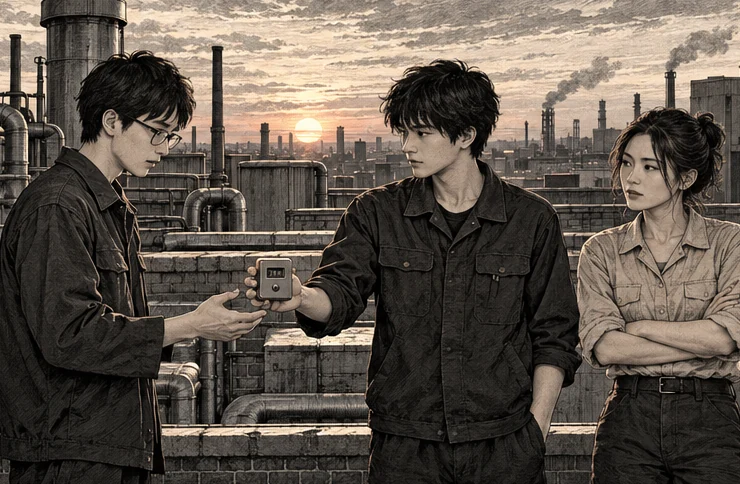
4:1Word of Haru and Mina quietly spread through the factory.
4:2“Those oddballs who let a machine decide everything.”
4:3At first it was a joke.
4:4But the laughter began to change.
4:5In negotiations with the foreman, Haru put forward a proposal he had chosen by a random number.
4:6By chance, it matched what management had in mind, and conditions improved for the entire department.
4:7“How did you see that coming?”
4:8His workmates were astonished. Haru answered honestly.
4:9“I used a random number. I thought something unpredictable might wrong-foot the other side.”
4:10They laughed again, but now there was a little envy in it, and a trace of awe.
4:11Among them was a young man reputed to have the sharpest mind in the factory. His name was Ren.
4:12He was a thoroughgoing determinist.
4:13Statistics, simulations, machine learning: he used every kind of model, believing the world was almost perfectly predictable.
4:14“Random numbers? Just an excuse for ignorance.”
4:15Ren pronounced his verdict.
4:16Then one day there was a serious accident on the factory line.
4:17An optimization algorithm Ren had written had failed to account for an unexpected pattern of breakdown.
4:18The injured escaped with minor wounds, but his pride was shattered.
4:19That night on the empty rooftop, Ren spoke to Haru.
4:20“…Show me those random numbers.”
4:21Haru handed him the Sacred Randomizer.
4:22Ren took a deep breath and pressed the button with the care of someone performing the first rite of a new faith.
4:23【314】
4:24“What does this number mean?”
4:25“Nothing. Any meaning it has, you give it.”
4:26That was Haru’s answer.
4:27After a long silence Ren murmured,
4:28“If there really is something unpredictable at the bottom of the world, the perfect model I believed in could never have existed in the first place.”
4:29Mina spoke up.
4:30“We aren’t asking you to throw away your models. Just to admit that outside them there’s a fluctuation you can never quite get inside a model.”
4:31Ren looked at the Sacred Randomizer. Very slowly, he nodded.
4:32“If you call that fluctuation God, I won’t believe. But I can accept it as a premise. The world seems settled, and then somewhere it always departs from the prediction. I want to know how it departs.”
4:33Haru smiled.
4:34“Sounds good. Welcome aboard, wavering determinist.”
4:35So the third Measurer came into being.
4:36His rationality, Haru’s intuition and Mina’s gentle sense of what was right came together.
4:37The Religion of Quantum Randomness was beginning to take form as a system of thought, beyond the private ritual it once had been.
Chapter 5 · Building the Temple of Random Numbers
5:1The three wrote their first articles of faith.
5:2These were simple rules to live by, with no claim to grand philosophy.
5:3Article One. What you can decide of your own will, decide for yourself.
5:4Article Two. When your will alone would bias a choice, entrust it to chance.
5:5Article Three. Never treat a random result as absolute. Take responsibility for what follows.
5:6A random number could bridge the gap where one could not decide. They gave it no claim to speak for the will of God.
5:7It was an odd kind of reverence, a little different from that of older religions.
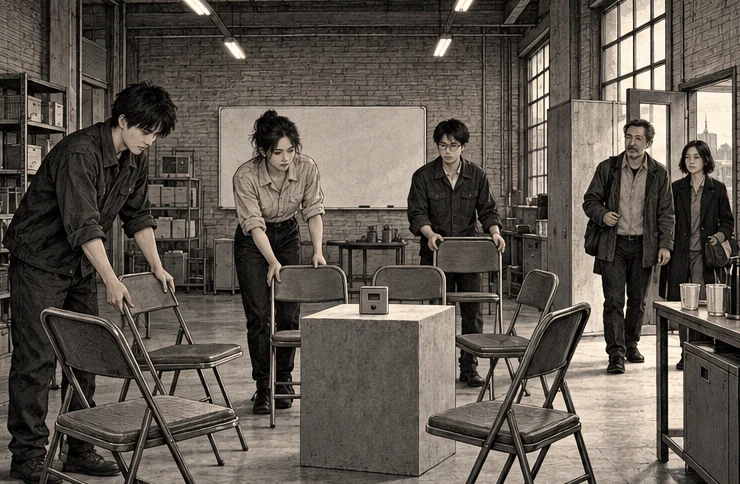
5:8In time the three rented an unused warehouse near the factory and made it into a small meeting place.
5:9On the wall, a whiteboard. Cheap chairs and tables.
5:10The Sacred Randomizer rested quietly on a stand in the middle.
5:11“So this is our Temple of Random Numbers?”
5:12Mina was half joking. Ren frowned.
5:13“It’s more of a laboratory. We’re here to observe, not pray.”
5:14Haru looked at them both and laughed.
5:15“Then let’s call it the Observation Room. But I’m sure people will pray here.”
5:16Friends from the factory, young people from the neighbourhood, the unemployed, students uncertain of their futures:
5:17little by little, having heard the rumours, people began coming to the Observation Room.
5:18The first question anyone brought them was a question of love.
5:19“Should I tell him how I feel?”
5:20The number was 【742】. The choice was yes.
5:21The confession went well, and the story spread in no time.
5:22The next question was about changing jobs.
5:23An uncertain job someone longed to do, or a secure job that bored them?
5:24The number chose the former. A few months later that choice brought a great opportunity.
5:25Of course it didn’t always turn out well.
5:26Failure and regret lay at the end of some paths chance had chosen.
5:27But something strange began to happen.
5:28Even when they failed, people no longer simply said they had been unlucky.
5:29“A fluctuation in the world led me this way. What meaning can I find in what happened?”
5:30On the Observation Room wall, people recorded their choices and the outcomes.
5:31Ren compiled their records and ran the statistics.
5:32He treated random numbers as his accomplices, not as objects of worship.
5:33“Look, Haru. People actually tend to be happier with choices they made by chance.”
5:34“Of course,” Mina laughed.
5:35“People only use the numbers when they think either choice might leave them with regrets. If they’d chosen for themselves, they’d spend the rest of their lives wondering about the road they hadn’t taken.”
5:36So the Observation Room, where statistics and prayer breathed the same air,
5:37took root in a corner of City Q as a temple of random numbers of a kind seldom seen in the world.
Chapter 6 · The Quantum Inquisition
6:1Word of the Observation Room reached beyond the factory and spread throughout City Q.
6:2The media, half in fun, presented it as a “quantum fortune-telling parlour.”
6:3It was hardly how Haru and his friends had wanted to be seen, but people flocked there all the same.
6:4Opposition came with them.
6:5To established religious leaders, this new movement that put random numbers in the place of the will of God
6:6was a dangerous heresy.
6:7The authorities, too, kept a watchful eye on this “dangerous group encouraging irresponsible decision-making.”
6:8The most uncompromising of its opponents was a body called the Committee for Determinist Ethics.
6:9Its members argued as follows.
6:10“Human beings must act for reasons. Responsibility arises only where it is joined to a reason. To follow a random number without a reason is to abandon responsibility and bring about the collapse of ethics.”
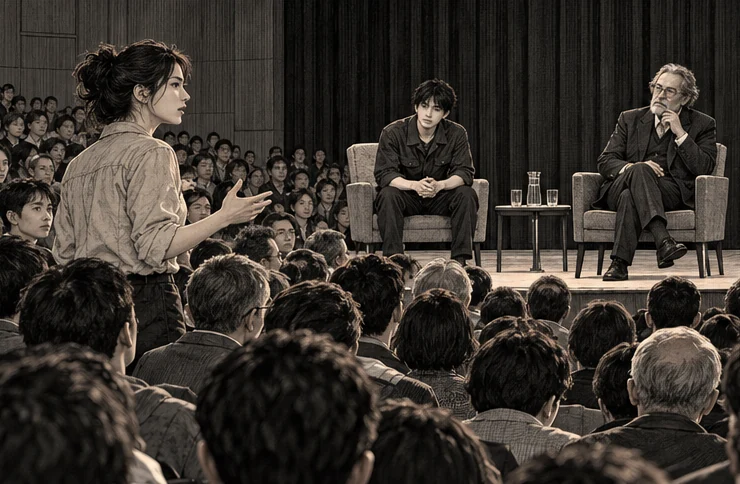
6:11A public debate was arranged.
6:12Onstage sat Orma, the philosopher representing the committee,
6:13and Haru, representing the Religion of Quantum Randomness.
6:14Orma put a question to him.
6:15“You say you entrust important decisions in life to chance. Is that not simply giving up thinking for yourself?”
6:16Haru shook his head.
6:17“No. First we think the matter through. We think and think, and only when we still cannot decide do we use a random number.”
6:18“But that final push is precisely what determines a life. Would you leave it to the world’s whim?”
6:19“The world has always been whimsical,”
6:20said Haru quietly.
6:21“At the quantum level and at the level of the human heart. We’ve pretended we don’t see that whim and rewritten the story as if everything had been necessary.”
6:22There was a murmur in the audience.
6:23Orma frowned.
6:24“But that is precisely why people must make meaning. Even if the world in itself means nothing, we give it meaning anew. That is culture. That is ethics. You are abandoning that work.”
6:25At that Mina stood up.
6:26“No. It’s the other way round.”
6:27Her voice shook, but it was clear and direct.
6:28“We don’t impose a meaning on the result a random number gives us. We don’t paint over the movement of the world with stories like ‘God willed this’ or ‘This is divine punishment.’
6:29We accept what happened as what happened, and then, on our own responsibility, we weave its meaning afresh. That may be a more exacting position than some older religions have taken.”
6:30Orma faltered for a moment, then spoke quietly.
6:31“…Your position is closer to philosophy than religion.”
6:32Ren grinned.
6:33“In that case, you can call us the Fellowship of Probabilistic Ethics.”
6:34Laughter broke out, and the tension in the hall eased a little.
6:35From that day on, public opinion shifted a little. The Religion of Quantum Randomness had gone from being a dangerous heresy
6:36to being “a strange bunch, but there’s something in what they say.”
Chapter 7 · City Q Branches
7:1Five years had passed since the Observation Room opened.
7:2City Q was changing, slowly but unmistakably.
7:3Some companies had begun using random numbers to settle on a final proposal from among several candidates.
7:4Their reason was to reduce human bias.
7:5In politics, too, certain seats were allocated by drawing lots, as was the order in which matters came up for debate.
7:6Public random number generators were being used for both.
7:7People were learning that fairness need not always mean choosing for a reason.
7:8Sometimes a fluctuation without a reason came closest to fairness.
7:9Elsewhere in the city, however, a different current was gathering.
7:10Some people used random numbers to evade responsibility.
7:11A man who had assaulted someone at home said in court,
7:12“I used a random number to decide whether to hit them. So it isn’t my responsibility.”
7:13A company executive who selected workers for redundancy at random announced,
7:14“If you want to blame someone, blame the number. Don’t blame me.”
7:15As such cases multiplied, criticism of the Religion of Quantum Randomness flared up again.
7:16Was its philosophy giving people a justification for shirking responsibility?
7:17The three were deeply hurt.
7:18They had said again and again that people must take responsibility themselves,
7:19and still their words were being twisted to suit whoever used them.
7:20“Did we get something wrong?”
7:21Ren murmured.
7:22Mina slowly shook her head.
7:23“We weren’t wrong. But what we did wasn’t enough. The teaching, the education, the conversations: none of it was enough.”
7:24Haru looked at the Sacred Randomizer at the centre of the Observation Room.
7:25“We’ve always seen the device as a window onto the world. But it was a mirror of human weakness too.”
7:26City Q had branched.
7:27Some used random numbers as an instrument for taking responsibility,
7:28others as a shield behind which they could escape it.
7:29Which branch would prevail
7:30was something no one had yet been able to observe.
Chapter 8 · Journey Through the Statistical Desert
8:1Amid the criticism and confusion, Haru and his companions made a bold decision.
8:2They would leave City Q and travel to other cities, sharing their teaching and talking it through with the people they met.
8:3When asked if they were running away, Haru answered,
8:4“No. We’re going out to share it. There are people farther afield we want to reach with a way of living that doesn’t lay its burdens on random numbers.”
8:5They entrusted the Observation Room to their disciples. Into a little van they loaded the bare essentials
8:6and a working copy of the Sacred Randomizer.
8:7The original stayed asleep in the safe at the back of the Observation Room.
8:8Along the way they entered a region called the Statistical Desert.
8:9There were hardly any data or records there.
8:10People lived by intuition and tradition alone.
8:11In one village, the headman asked Haru,
8:12“What difference is there between these random numbers of yours and fortune-telling?”
8:13Haru thought a while before he answered.
8:14“Fortune-telling assigns a meaning to a result. ‘This is how it came out, so this is the sort of person you are.’
8:15A random number assigns no meaning. Whatever number comes out, it simply asks in return, ‘What meaning will you give it?’”
8:16The headman narrowed his eyes.
8:17“In other words, your numbers hold a mirror up to the human heart.”
8:18Mina nodded.
8:19“Yes. We’re travellers who carry a mirror.”
8:20They spent days talking with the young people of the village.
8:21Tradition and chance, responsibility and freedom, fear and hope.
8:22Sometimes a random number moved a conversation forward. Sometimes it brought it to a halt.
8:23Looking up at the desert night sky, Ren murmured,
8:24“If fortune-telling reads the stars to tell a person’s fate, we ride the fluctuations of the vacuum to question fate anew. In the end I suppose they’re both stories.”
8:25Haru laughed.
8:26“But we try not to set the ending of the story in stone. We go on living in the belief that it can always branch again.”
8:27Mina said quietly,
8:28“Then what we’re really doing is spending our lives in superposition.”
8:29The three looked into the campfire.
8:30At every instant the flickering flame had a definite form,
8:31but no one could predict the next one.
8:32That night Haru had a dream.
8:33He saw the Observation Room of City Q branching into two utterly different futures.
8:34In one stood a city of people who accepted responsibility.
8:35In the other, a city of people who fled it.
8:36When he woke, he longed to know which future would become real.
8:37Yet he did not touch the Sacred Randomizer.
8:38“Here’s a random number I mustn’t observe.”
8:39He murmured the words, and simply waited for dawn.
Chapter 9 · The Last Random Number
9:1When they returned, City Q had changed beyond recognition.
9:2The Observation Room had expanded, and smaller satellite rooms had opened all over the city.
9:3Their disciples had kept faith with the teaching of Haru and his friends,
9:4and yet each had developed it in a different way.
9:5Foremost among them was a girl called Yuna, who had become Haru’s leading pupil.
9:6She brought random numbers into education and devised her own programme to teach the courage of trial and error.
9:7The children used random numbers to make choices that might go wrong.
9:8Together they observed the outcome, analysed it, laughed it off and put what they had learned to use the next time.
9:9“The future isn’t settled. And precisely because it isn’t settled, you can choose again, as often as you need.”
9:10That idea had taken deep root in the next generation.
9:11At the same time, the habit of using random numbers to dodge responsibility had never quite disappeared.
9:12City Q still wavered between two branches.
9:13The years passed. Haru and his friends grew old.
9:14Countless fingerprints marked the metal skin of the Sacred Randomizer.
9:15Its button sat a little crooked, and its display had grown dim.
9:16One day, returning from the doctor, Haru gathered his friends in the Observation Room.
9:17“It seems my story function will soon be subject to a terminal condition.”
9:18He announced it quite calmly.
9:19He was seriously ill. There was as yet no established treatment.
9:20Everyone wept, raged, struggled to accept it.
9:21Yet there was one question no one voiced.
9:22Would he let a random number decide whether he lived or died?
9:23It was Haru himself who feared that question most.
9:24Should he entrust his life to a number in the name of faith?
9:25Or should he, at least this last time, decide by his own will alone?
9:26A few days later, he gathered everyone again and began to speak quietly.
9:27“I’m going to have treatment. Even if the odds are low, I’d like to try for extra time. I won’t use a number to decide this. It’s my story. I want to write it myself.”
9:28Wiping her eyes, Yuna asked him,
9:29“But, Teacher, as the last teaching of the Religion of Quantum Randomness, is there anything you’d still like to ask a random number?”
9:30After a long silence, Haru gathered the Sacred Randomizer to his chest.
9:31There was something warm about the metal.
9:32“…Then just once more, for the last time.”
9:33Everyone assembled in the Observation Room.
9:34Old companions and newly arrived Measurers alike.
9:35All looked on with bated breath.
9:36Haru closed his eyes and quietly framed his question.
9:37“This road we’ve followed: was it noise to the world? Or was it a fluctuation that meant something?”
9:38The question was something like a prayer and something like a self-diagnosis.
9:39Haru laid his finger on the button.
9:40The click echoed through the Observation Room.
9:41The display showed the final random number.
9:42【001】
9:43At first sight, just a small number with no special significance.
9:44Everyone drew a sharp breath.
9:45A random number has no meaning.
9:46Yet everyone there longed to give this number one.
9:47It was Mina who broke the silence.
9:48“…Yes. I see.”
9:49She smiled.
9:50“To the world, I expect we’re something like ‘001’. Just one tiny pattern among innumerable strings of bits.
9:51But this ‘001’ is one we know. This is a number we can laugh and cry over. Isn’t that enough?”
9:52Haru listened and smiled quietly.
9:53“Yes. I think it is. In the noise of the world we found a meaning all our own. Perhaps that was all there ever was to the Religion of Quantum Randomness.”
9:54From that day on, the Sacred Randomizer fell silent.
9:55Its components had reached the end of their lives. It would never start up again.
9:56But the faith in superposition that lived in the people
9:57passed quietly and surely to the next generation.
After Decoherence
10:1More time had passed since Haru left this world.
10:2City Q changed, and the Observation Room changed with it.
10:3In place of the Sacred Randomizer there now stood rows of the latest quantum chips.
10:4Yet Yuna never set Haru’s teaching in stone as doctrine.
10:5This was what she said.
10:6“What our teacher feared most was that the Religion of Quantum Randomness would take on one fixed form. If the world is in flux and we alone stand still, that would be a lie.”
10:7So there was always a current edition of the fellowship’s teaching.
10:8Every year the doctrine was debated, revised, and in parts discarded.
10:9Even Haru’s own words, if they were judged no longer suited to their time,
10:10could be relegated without ceremony to a footnote.
10:11Outsiders saw this and mocked them for a lack of faith.
10:12Those inside understood.
10:13The very proof of their faith was their willingness to keep on fluctuating.
10:14Once, a child asked Yuna a question.
10:15“Is the world really not settled?”
10:16Yuna considered a moment and replied,
10:17“I don’t know.”
10:18“Then why do we care so much about random numbers?”
10:19“Whether the world is settled or not, we need to be able to think that perhaps it isn’t.”
10:20The child tilted their head.
10:21“What happens when we can think that maybe it isn’t settled?”
10:22Yuna smiled.
10:23“We stop making up our minds about other people’s pasts. We don’t so readily stick a label on someone and say, ‘That’s the sort of person they are.’
10:24When we fail, we stop thinking, ‘That’s the end of it.’ Because we can believe there might always be another branch.
10:25And then…”
10:26She looked out of the window at the city.
10:27“It gets a little easier to forgive ourselves, or someone else. Instead of saying, ‘There was nothing else I could have done,’ we can say, ‘That’s what I chose at the time.’”
10:28The child thought for a while and then laughed.
10:29“Then the Religion of Quantum Randomness is a religion for looking at yourself and other people a little more kindly.”
10:30Yuna’s eyes widened. Then she nodded with delight.
10:31“Yes. I think if our teacher heard that, he’d say he liked your definition.”
10:32Night came. The Observation Room fell silent.
10:33In the old safe lay the Sacred Randomizer, incapable of moving.
10:34No one switched it on. The box would never show another number.
10:35Yet even its silence was a kind of random outcome,
10:36to which people somewhere in their hearts were giving meaning.
10:37The story has been told.
10:38But the wave of possibilities does not vanish.
10:39Even as you finish reading,
10:40on another worldline Haru and his friends may be making entirely different choices.
10:41There is no way to find out.
10:42That is why the choices you make in this world, the one where you live, matter.
10:43And now, for you who stand outside this story,
10:44let us offer just one small article of faith. Article Zero. In a world that may have been predetermined, or may not have been, you may still go on choosing your own next step.
10:45That is the last verse of the Religion of Quantum Randomness,
10:46and the last verse of this story told in the manner of scripture.