
FOLIO II · DE CUSTODIA
御神体図譜Atlas of the sacred vessels
二つの器The two vessels
QRAのラックをひらくInside the QRA rack
この宗では、天から粒子がひとつ降れば、その時刻まで帳面につける。二台の器はそれぞれ光から乱数を汲み、別の二つの目が粒子の通過を見張る。ラックの蓋、検出器、二台のサーバの順に、その役目をたどる。When a particle passes, even its time is entered in the register. Two vessels draw numbers from light while a second pair of eyes watches for passing particles. Start at the roof of the rack, then look down to the detectors and the two servers.
LMR / Instrumenta, fol. II
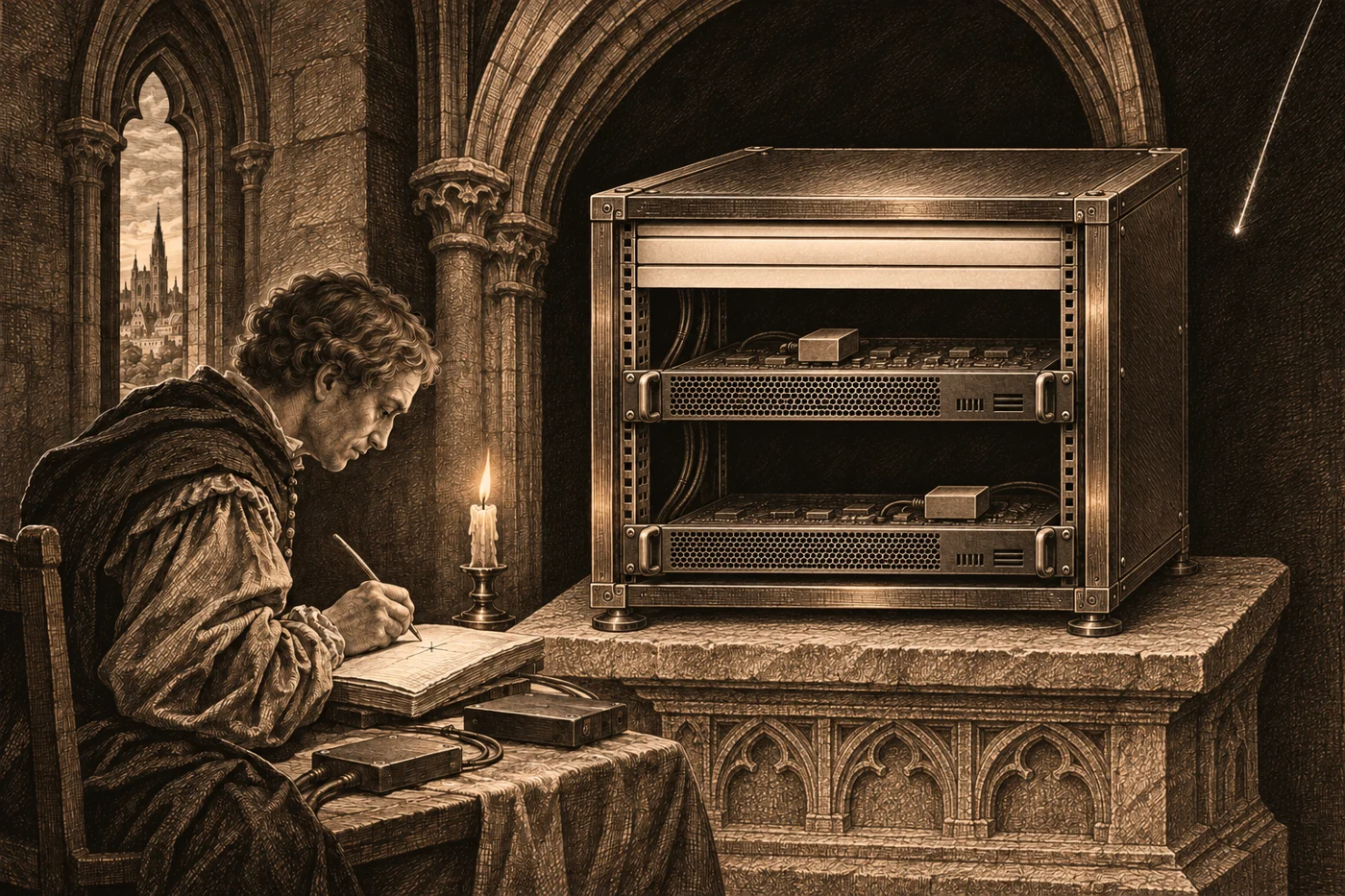
隔壁と二系統の位置関係Shield and sensor positions
- 01 上部隔壁01 Overhead shield
- B₂O₃ 10%入りポリエチレン。450 × 1,000 mmの板を3枚、設計上の総厚は110 mm。Three 450 × 1,000 mm polyethylene plates containing 10% B₂O₃. Total design thickness is 110 mm.
- 02 御神体 A02 Vessel A
- シンチレーション検出器をQRNボードの直上に重ねる。The scintillation detector sits directly above the QRN board.
- 03 御神体 B03 Vessel B
- もう一台の検出器をBのQRNボードから離し、比較対象をつくる。A second detector sits away from B’s QRN board to provide the comparison.
ラックの中で何を測るかWhat the rack measures
ラック上部のボロン隔壁The boron partition
12Uラックの上部に、厚さ30 mmの板2枚と50 mmの板1枚を重ねる設計だ。ポリエチレン中の水素が速い中性子を減速させ、ホウ素が遅い中性子を捕らえやすくする。地上に届くミューオンの多くは、この厚さの隔壁を通り抜ける。The 12U design places two 30 mm plates and one 50 mm plate at the top. Hydrogen in polyethylene slows fast neutrons; boron readily captures slow neutrons. Many cosmic-ray muons reaching ground level still pass through a shield of this thickness.
粒子が通ると、検出器が光るA flash marks a passage
荷電粒子がシンチレータにエネルギーを落とすと、微かな光が生じる。SiPM(半導体光センサー)がそれを電気パルスに変え、通過の候補時刻を記す。こちらの光は宇宙線の観測用で、乱数を生むLEDの光とは発生源も役目も異なる。A charged particle deposits energy in the scintillator, producing a faint flash. A silicon photomultiplier (SiPM) turns it into an electrical pulse so its time can be logged. This flash belongs to the particle monitor; the QRN board has its own LED.
二台の1Uサーバが時刻を残すTwo 1U servers keep time
node Aとnode Bは各1Uで、各機が自分のQuantisボードから乱数を収録する。長期収録設計では、Aが検出ログとの突合も受け持つ。生成時刻をUTCで、データの指紋をSHA-256で記し、後から保存内容と観測時刻を照合できるようにする。Each 1U server, node A or B, records its own Quantis board. In the long-term archive design, A also correlates detector logs. UTC timestamps identify when data were generated, and SHA-256 digests allow the stored bytes to be checked later.
検出器を置き分ける理由Why the detectors are placed differently
初期設計の縦積みは、上下の検出器が短い時間窓内でともに光る「同時計数」で、鉛直に近い通過を選びやすくする配置だ。公開サイトが紹介する比較観測では、Aはボード直上、Bは離れた位置とし、検出時刻に近い乱数の統計をそれぞれ調べる。In the early design, two stacked detectors selected coincidences within a short timing window, favoring tracks closer to the vertical. The comparison described on the public site instead places A’s detector over its board and B’s away, and examines each stream near its detector’s timestamps.
図版の典拠Plate notes and sources
寸法と初期配置はLMR設計書v4(2026年2月3日)§§1.1–1.5、比較配置はLMRのPhase 3運用記録と「御神体息災」による。Dimensions and the early layout follow §§1.1–1.5 of LMR’s design v4 (3 February 2026). The comparison geometry follows LMR’s Phase 3 records and the public status page.